
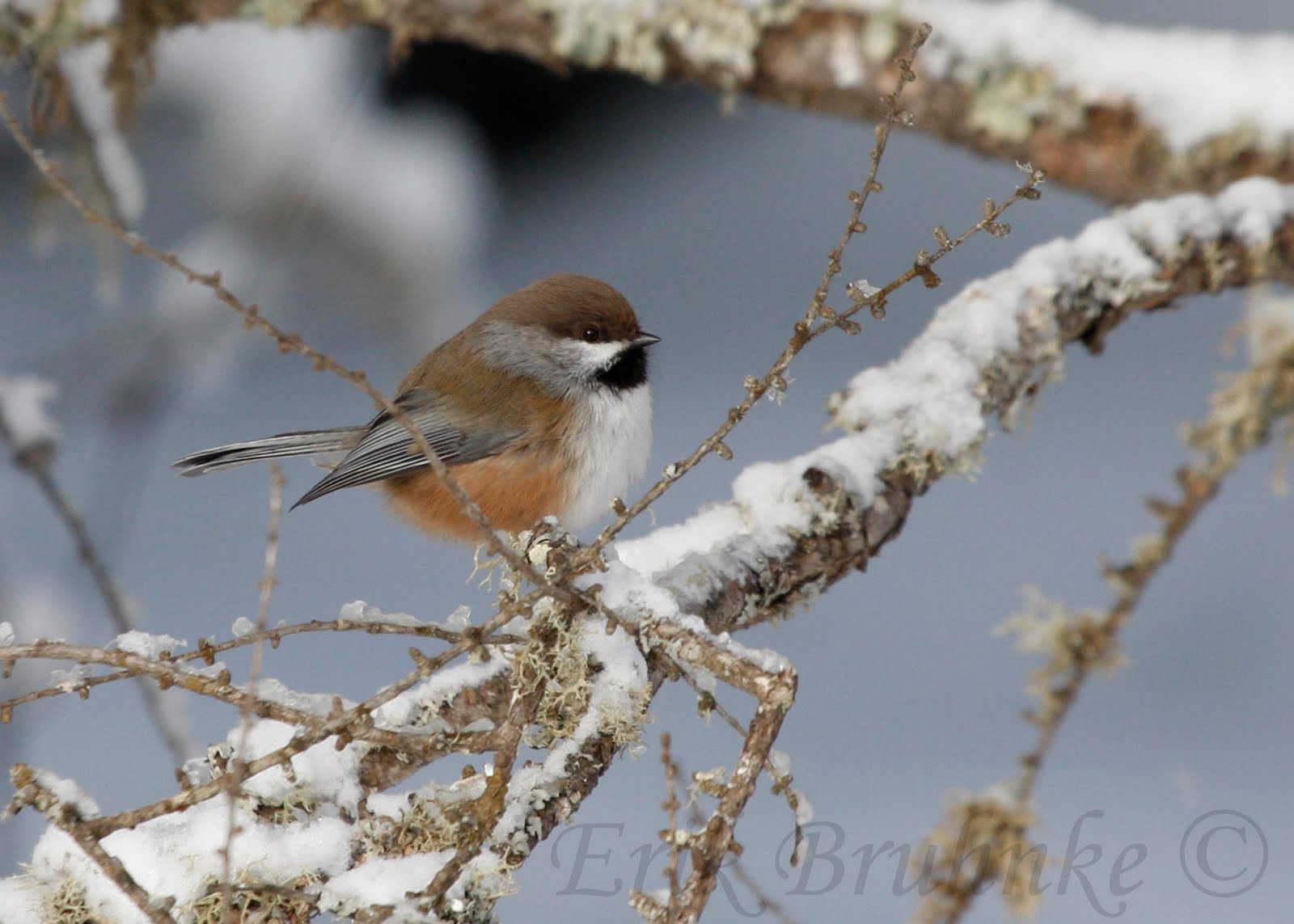
Black-capped Chickadee (above) and Boreal Chickadee (right)
Yesterday I showed a friend from Northland College around the bog. She had never visited a true bog before, and I told her (as we were leaving for the bog at a little before 7am this morning), "you're in for a treat." My goodness, as with every trip that I make up to the bog, there is something new to see, some unique behavior or habitat tidbit to ponder about, and wildlife to see. During this last visit to the bog, we even got to see a Porcupine sleeping in a Tamarack, and Meadow Vole scurry along the edge of the plowed road.
 One of the biggest surprises came from one of the smallest birds in the bog. In my previous visits to the bog this winter, I had been seeing two Boreal Chickadees visiting one of the birdfeeding stations at a time. They are so beautiful and cute, and are always seen together. Yesterday, a 3rd Boreal Chickadee joined-up with them, and all three Boreal Chickadees were feeding together. I've noticed that they occasionally partake in swift "dogfighting" scenarios; where they chase other chickadees into the woods.
 During the winter, most songbirds stick to calls, and refrain from much singing, if they even sing at all during the cold winter months. Songs are typically performed to attract birds of the other gender (same species) to the area. Singing is usually related to breeding, with songbirds. The songs of songbirds are sung most often by the males, however there are a few species where females will sing during the breeding season. (A male Pine Grosbeak is shown to the left)
Some songbirds will sing to mark territory, but with most songbirds, this is where the calling begins. Calls are often performed in offense/defense behaviors, like scolding a predator for being in a songbirds' territory, or to scare-off another potential nearby mate (of the same species), or to keep other songbirds from a feeding area. The Black-capped Chickadees give a "chicka-dee-dee-dee" call. You may have heard this in your backyard before! Their song, typically heard during the spring and summer, is the "you-huuuuu" or "cheese-burrrger" song. They also give a gurgly call, which is often produced while eating, or close proximity to food that they are eye-ing up.
Click this link to hear Black-capped Chickadees calling and singing!
On very clear and sunny days, even in mid-winter, sometimes songbirds can't help but sing a few times. Songbird vocalizations are very complex, but it is thought that photo-period (amount of light in a day) can encourage/discourage birds to sing, or at least creates/halts
 that urge to sing. As the days become longer in the spring and summer, birds sing more. Pay attention to the birds singing during a clear, beautiful spring or summer day. You will likely hear birds all over (while you're standing around wooded areas, or maybe some vegetated areas of your neighborhood will help be where the bulk of the birds are). Stand outside again, on a cloudy spring/summer day, if not a rainy day. Hear the difference? :-) A Boreal Chickadee eating seed is pictured to the right.
Going back to the chickadee vocalizations... Boreal Chickadees have a similar, but slightly different call and song that they produce, in relation to the Black-capped Chickadees call and song. Boreal Chickadees have an adorable, high-pitched and raspy "chick-a-deeeeeeeeeee"
call. I have also noted Boreal Chickadees in Sax-Zim Bog producing an unusual gurgled call, somewhat similar to the Black-capped Chickadee's gurgle call, but just a hair different... and Cornell says that they lack a whistled-song. I'm not sure what these individual Boreal Chickadees have been calling-about, but they sure are fun to watch and listen to!
Click this link to hear a Boreal Chickadee call!
Another highlight of yesterday was seeing a total of 8 AMERICAN CROWS throughout the bog. They are not rare of course, but seem unusual from the majority of the large black corvids that I have seen in the
 bog throughout most of my past visits (Common Ravens are the predominant corvid species in the bog, with Blue Jays at some feeding stations, and Gray Jays scattered throughout much of the densely-wooded sections of the bog. (The sleeping porcupine is pictured to the left)
Here are the bird species observed on this trip:
Rough-legged Hawk - 2
Bald Eagle - 1

Downy Woodpecker - 1
Hairy Woodpecker - 2
Northern Shrike - 4
Blue Jay - 4
Gray Jay - 9
American Crow - 8!
Common Raven ~20
Black-capped Chickadee ~20
Boreal Chickadee - 3
Red-breasted Nuthatch - 2
Pine Grosbeak ~50
*A Gray Jay is the photographed bird to the right of the bird list.
Quiz photo... which undertail coverts
 belong to which chickadee species?
Thanks again for reading my blog!
Good birdwatching,
Erik


