Showing posts with label bog. Show all posts

Thursday, February 10, 2011

Experiencing the life of a Northern Hawk Owl


Over the past week, I've visited Sax-Zim Bog on two separate occasions. The first visit was with a friend from Hawk Ridge. We saw some wonderful birds, including a Northern Hawk Owl and a Great Gray Owl, all in the same day! The second visit to the bog was showing 5 friends around on a guided tour, and although we didn't see a Great Gray Owl, we saw nearly every other bird that can be seen in the bog! If that doesn't get the heart racing... I don't know what does!

Owls are unique and beautiful in their own way, but seeing them, in their preferred habitat is so cool! The Great Gray Owl and Northern Hawk Owl are both habitat specialists. A habitat specialist is a species that is found in a single/small variety of habit types. Northern Hawk Owls are typically a Canadian Boreal Forest species. Lucking for any nature-lover in northern Minnesota, there is a small stretch of Boreal Forest that stretches from Canada southward, along the North Shore of Lake Superior. Northeastern Minnesota is one of the few places in the entire lower 48 states to see Northern Hawk Owls!! Great Gray Owls love the Boreal Bogs, however they can also be found in mixed dense forests (thick deciduous over there.... coniferous over there... mixing in the middle) - yeah, that's what makes their home, their home. The most reliable spot to find these two owl species would be to visit a bog, and that's what Sax-Zim Bog consists of. A Beautiful Black Spruce Bog.

There is something about being there in the moment with these beautiful owls. To give you a feel of what it was like observing the Northern Hawk Owl, imagine looking at the owl shown in the adjacent photo. The falcon-shaped body and bull-headed owl turns to you... The beautiful yellow eyes produce a deep and almost trance-like gaze. The yellow bill is well insulated, tucked in the thin bristles around the bill (most birds have what are called rictal bristles, which are stiff "hairs" that line the outer edge of bill). The beautiful rusty-colored barring just glows against the contrasting head of the owl, which is covered by an elaborate helmet of black, white and subtle grays, and is even finer-detailed in white speckles. Now imagine this owl staring at you, then turning away in a quick and abrupt fashion. Movements with owls are quick and brief. Drawn-out movements can will only advertise the owls' presence. It doesn't take an owl to know that being mobbed by crows is unpleasant.

The owl stares at the snow in the other direction, away from you. It rocks back and forth, doing a little dance of shifting feet on the branch as the wind gusts test the owls' balance atop the branches. Northern Hawk Owls have well-insulated feet, to keep the feet warm during those harsh winter months which they experience every winter of their life. Quickly, the owl's attention is focused towards a slightly different spot in the snow... It triangulates (I will get back to the owl story in a moment)...

Triangulates? What the heck is that? The owl is actually hearing in 3-D! Here is how it works; Unlike humans, and most other living creatures that can hear, the owls have a unique ear setup (the ears are actually offset in non-symmetrical places on the sides of the head). It's a subtle difference, but by having one ear placed on the upper side of the head, and the other ear being lower on the opposing side, the ears will hear sounds at slightly different times. By having two ears independently located in different locations, the sounds that the bird hears will reach each ear at an ever-so-slightly moment. As a result of this, the owl not only hears how loud or soft something is, but also "hears" distance and depth. Here are two little tests that that you can do to see what I am talking about with the owls' unique senses.

Look at something complex in your house, maybe a cluttered desk, or a freshly-set dinner table, or maybe some birdfeeders out the back windows. Notice how you can see the far and close items, and get a sense of depth. Then, close one eye, keep looking at the same items, and notice how you cannot get that same depth perception. Your brain is only connecting a one-plane view to your eye, and that's what makes the view seem flat. Having two eyes open allow your brain to combine two angles into one "observed image," which produces the depth in what you see. The owl's ears work in a similar way with deciphering distance and depth. But, there's more that you have to do, in order to get a feel for what the owls hear!

Listen to some music, walk to the other side of the room that the music is playing in, and close your eyes. Relax. Cover one of your ears with your hand... wait a few moments, and try your best to point where the music is coming from. Tricky, huh? Your are hearing in a one-plane atmosphere. Now, take the one hand off your covered ear (eyes closed. no peeking)! Notice how right away, you get a sense of direction that the music is coming from? Now, even though this is beyond human, imagine combining the depth-deciphering abilities of two open eyes, with the direction-deciphering sound-listening abilities of two open ears, and make that an all-in-one sense of hearing. As humans, we don't hear in this complex manner, but this specialized sense allows owls to "see" under the snow, with their ears. :-) They can hear the little rodents running under the snow, and figure out exactly where the mouse is!


Triangulating is when the owls rocks the head back and forth, staring at once spot, to get a feel for "ok, with my head being here, the sound is that far. Now, with my head being a few inches over, the little critter is exactly there, under the snow." Now back to experiencing the Northern Hawk Owl...

So the owl triangulates, crouches, then freezes..... stands up again, crouches, and stares. The wind blows, but the owl is unaffected. Cars may drive by, and the owl is unaffected. Hyperfocusing has taken place, and the owl gets ready for an all-out hunt! It pounces off of its perch, wing are closed for a moment, momentarily looking like a feathered bulled. The wings flap once, twice, and the stealth-bomber wing formation takes place. The swift and near-silent owl hits the snow; then silence.

Immediately after piercing the layer of snow, the owl provides a complimentary talon-massage for the rodent. Birds of prey kill their prey using only their talons. A bill is never used to kill a live animal, as it is much safer to do damage at a distance (with long legs), than for the owl to risk potentially lose an eye, fracture a bill, etc. The owl flies up to the nearest snag, to enjoy a well-earned meal.

Good birdwatching,
Erik

Friday, January 28, 2011

Chickadees of the north, bird vocalizations and more!

Sax-Zim Bog guided trip - January 28, 2011


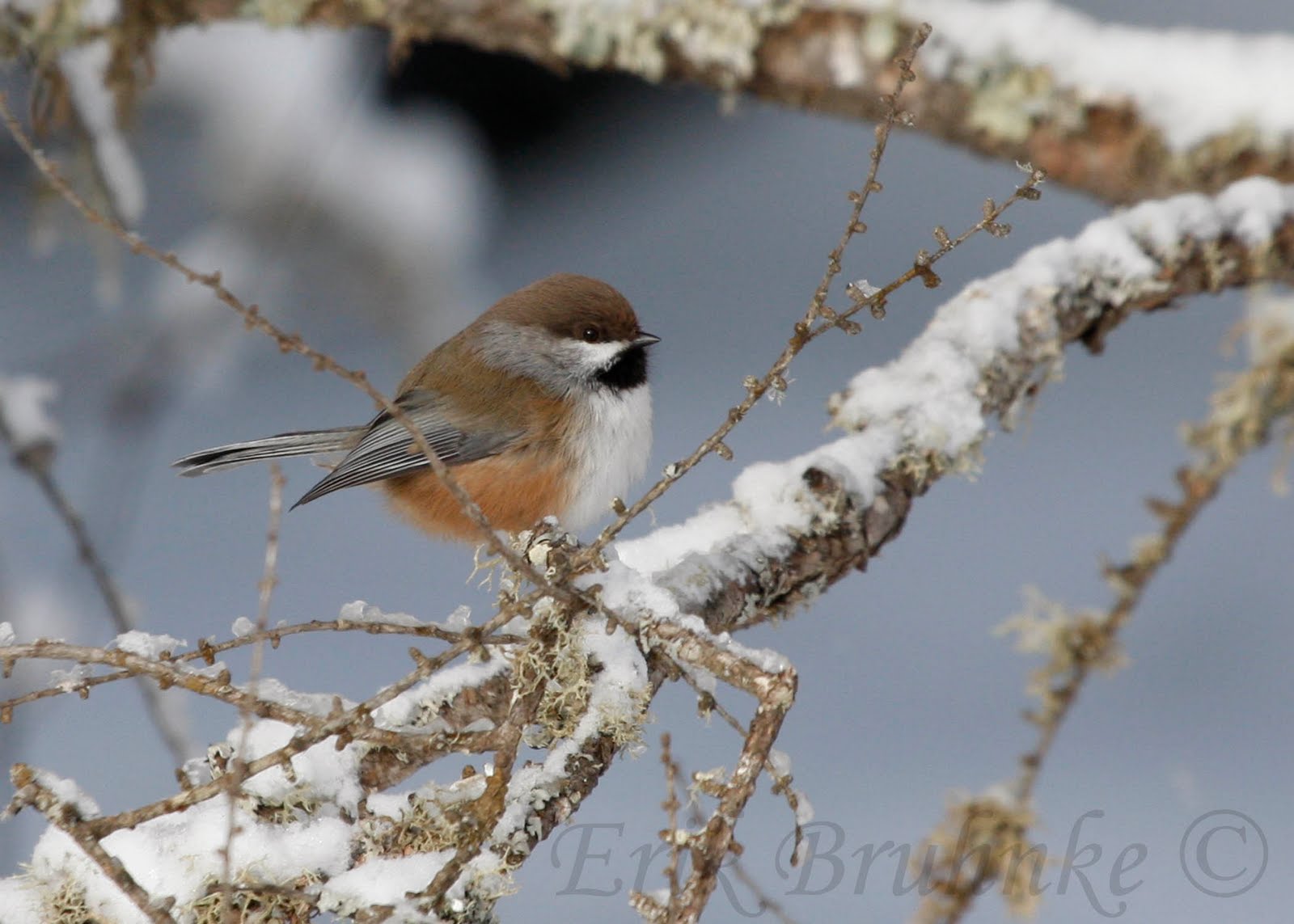
Black-capped Chickadee (above) and Boreal Chickadee (right)


Yesterday I showed a friend from Northland College around the bog. She had never visited a true bog before, and I told her (as we were leaving for the bog at a little before 7am this morning), "you're in for a treat." My goodness, as with every trip that I make up to the bog, there is something new to see, some unique behavior or habitat tidbit to ponder about, and wildlife to see. During this last visit to the bog, we even got to see a Porcupine sleeping in a Tamarack, and Meadow Vole scurry along the edge of the plowed road.

One of the biggest surprises came from one of the smallest birds in the bog. In my previous visits to the bog this winter, I had been seeing two Boreal Chickadees visiting one of the birdfeeding stations at a time. They are so beautiful and cute, and are always seen together. Yesterday, a 3rd Boreal Chickadee joined-up with them, and all three Boreal Chickadees were feeding together. I've noticed that they occasionally partake in swift "dogfighting" scenarios; where they chase other chickadees into the woods.

During the winter, most songbirds stick to calls, and refrain from much singing, if they even sing at all during the cold winter months. Songs are typically performed to attract birds of the other gender (same species) to the area. Singing is usually related to breeding, with songbirds. The songs of songbirds are sung most often by the males, however there are a few species where females will sing during the breeding season. (A male Pine Grosbeak is shown to the left)

Some songbirds will sing to mark territory, but with most songbirds, this is where the calling begins. Calls are often performed in offense/defense behaviors, like scolding a predator for being in a songbirds' territory, or to scare-off another potential nearby mate (of the same species), or to keep other songbirds from a feeding area. The Black-capped Chickadees give a "chicka-dee-dee-dee" call. You may have heard this in your backyard before! Their song, typically heard during the spring and summer, is the "you-huuuuu" or "cheese-burrrger" song. They also give a gurgly call, which is often produced while eating, or close proximity to food that they are eye-ing up.

Click this link to hear Black-capped Chickadees calling and singing!

On very clear and sunny days, even in mid-winter, sometimes songbirds can't help but sing a few times. Songbird vocalizations are very complex, but it is thought that photo-period (amount of light in a day) can encourage/discourage birds to sing, or at least creates/halts that urge to sing. As the days become longer in the spring and summer, birds sing more. Pay attention to the birds singing during a clear, beautiful spring or summer day. You will likely hear birds all over (while you're standing around wooded areas, or maybe some vegetated areas of your neighborhood will help be where the bulk of the birds are). Stand outside again, on a cloudy spring/summer day, if not a rainy day. Hear the difference? :-) A Boreal Chickadee eating seed is pictured to the right.

Going back to the chickadee vocalizations... Boreal Chickadees have a similar, but slightly different call and song that they produce, in relation to the Black-capped Chickadees call and song. Boreal Chickadees have an adorable, high-pitched and raspy "chick-a-deeeeeeeeeee"
call. I have also noted Boreal Chickadees in Sax-Zim Bog producing an unusual gurgled call, somewhat similar to the Black-capped Chickadee's gurgle call, but just a hair different... and Cornell says that they lack a whistled-song. I'm not sure what these individual Boreal Chickadees have been calling-about, but they sure are fun to watch and listen to!
Click this link to hear a Boreal Chickadee call!


Another highlight of yesterday was seeing a total of 8 AMERICAN CROWS throughout the bog. They are not rare of course, but seem unusual from the majority of the large black corvids that I have seen in the bog throughout most of my past visits (Common Ravens are the predominant corvid species in the bog, with Blue Jays at some feeding stations, and Gray Jays scattered throughout much of the densely-wooded sections of the bog. (The sleeping porcupine is pictured to the left)


Here are the bird species observed on this trip:
Rough-legged Hawk - 2
Bald Eagle - 1
Downy Woodpecker - 1
Hairy Woodpecker - 2
Northern Shrike - 4
Blue Jay - 4
Gray Jay - 9
American Crow - 8!
Common Raven ~20
Black-capped Chickadee ~20
Boreal Chickadee - 3
Red-breasted Nuthatch - 2
Pine Grosbeak ~50
*A Gray Jay is the photographed bird to the right of the bird list.


Quiz photo... which undertail coverts belong to which chickadee species?


Thanks again for reading my blog!
Good birdwatching,
Erik


Tuesday, January 25, 2011

Dark morph Rough-legged Hawks & more about the bog


No matter how many times I visit Sax-Zim Bog, I get the rush that I felt the first time I ever visited the bog, back during the owl irruption of 2004-2005. I remember taking a drive with two of my college friends, carpooling of course, during my first long-distance birdwatching trip. I was just giddy with excitement. At the time, I had never seen a wild owl, and was filled with the curiosity of wanting to experience the sights and sounds of this bog. At that point in my life, I was unaware of the fascinating behaviors of the food-caching Gray Jays, the bark-peeling of Three-toed and Black-backed Woodpeckers, the the concept of how much of a rare treat it is to see Boreal Chickadees, especially anywhere in the lower 48. Pine Grosbeaks... I had seen pictures of these chunky finches in field guides, but I did not know that they roam the skies and tree tops of the bog, in tight-knit flocks.

We arrived at the gas station just outside of the bog at the "Cotton" intersection a little before the sun came up, to get some snacks for the upcoming day of birdwatching that awaited just a few miles west. Shortly after entering the bog, we headed north on Hwy 7. What was this raptor to the right... sitting on a fence post? It made me think of a perched Red-tailed Hawk that had been dipped in dark-chocolate, from head to tail. I noticed the bird had a slightly longer-looking tail than a Red-tailed Hawk, and a more boxy-appearance down to the feet. Red-tailed Hawks can look poofy and fluffy, but this raptor had a sense of being relaxed and fluffy all at once! My friends Becca and Andrew told me that this bird is a dark morph Rough-legged Hawk. Wow, my very first Rough-legged Hawk! And what is a dark morph, I wondered at the time... Dark morph is a term given for raptors that have an overdose of melanin, or brown/gray/black coloration throughout their feathers, where typically paler sections of feathers occur. If you hear the term melanistic (too much melanin), it can sometimes refer to birds that are unusually dark for their species. I love gulls and gull watching, and will later share photos of a melanistic Ring-billed Gull I photographed this past fall. Anywho, back to the bog...


We must have watched that Rough-legged Hawk for over 20 minutes. It was a natural moment of bliss. The arctic-dwelling fluffball, as I like to call the Rough-legged Hawk was at ease. It slowly looked left, looked right, then quickly snapped its head back to the right; this time remaining focused on the snow. The intent stare of raptors is powerful. They hyperfocus, and remain focused on their prey as if life and death could be just around the corner... because it is. Birds of prey hunt for survival, and on average make a successful hunt once every seven attempts. I don't remember if this Rough-legged Hawk was successful, but I do remember the actions, the beauty of this bird seen through snow-globe snowflakes falling that day, and remember a special connection with this raptor. That day as a whole was incredibly memorable, as we saw over a dozen Great Gray Owls, several Northern Hawk Owls, Black-billed Magpies, and songbirds of every kind to be expected within the heart of a Boreal Bog.

The photos throughout this blog entry are of Rough-legged Hawks (and the habitat scene on top, from Sax-Zim Bog). The paler-looking Rough-legged Hawk is a light-morph. Like all Rough-legged Hawks, they have a dark carpal patch (black spot in the "wrist" or mid-section of the wing). This is something to look for when you're trying to identify them in flight.As stated earlier, Rough-legged Hawks can also exist in a dark-morph form. Rough-legged Hawks are one of the few raptors that you can actually tell the gender, mainly by the amount of speckling on the frontside of the bird, as well as the band thickness/number of bands on the tail.


Rough-legged Hawks come from the arctic regions of northern Canada, and come down "here" to the northern regions of the lower 48 to spend their winter months. Their ability to cope with the cold conditions during winter, as well as their amazing beauty is really something else :) Only a few more months until these pretty arctic fluffballs head back to the Arctic. Time to enjoy them while they are here!

Good birdwatching,
Erik